
If you’re working from home in 2026, you’ve likely upgraded your chair, your desk, and your Wi-Fi. But there is one piece of "office equipment" you might be neglecting - and it happens to be the primary driver of your energy, mood, and sleep: Light.
In the current wellness landscape, we are moving beyond simple "blue light filters." The most en vogue trend for high-performing remote workers is Full-Spectrum Light Literacy. It’s the art of designing your environment to sync with your circadian rhythm, turning your home office into a biological "rhythm-setter."
The Cost of "Biological Twilight"
Most remote workers live in a state of perpetual "biological twilight." We sit in rooms with consistent, dim overhead lighting while staring at hyper-bright screens. To your brain’s suprachiasmatic nucleus (the master clock), this is confusing. You aren't getting enough "bright" signals in the morning to feel alert, and you're getting too many "blue" signals at night to feel sleepy.
This misalignment leads to "Social Jetlag" - a state where your body is physically in one time zone, but your internal clock is wandering somewhere over the Atlantic. The result? Persistent brain fog, midday energy crashes, and that frustrating "tired-but-wired" feeling at 11:00 PM.
The Circadian "Stack": Morning Sun & Evening Red
The trend in 2026 isn't about buying one fancy lamp; it’s about a dual-light strategy that anchors your day.
1. The Morning "Anchor": Blue-Enriched Daylight
The most important "supplement" for your productivity is viewed through your eyes, not swallowed in a pill.
- The Science: When bright, full-spectrum light (specifically the blue wavelengths found in morning sun) hits your retinas, it suppresses melatonin and triggers a healthy spike in cortisol. This isn't just about waking up; it sets a timer for your sleep 16 hours later.
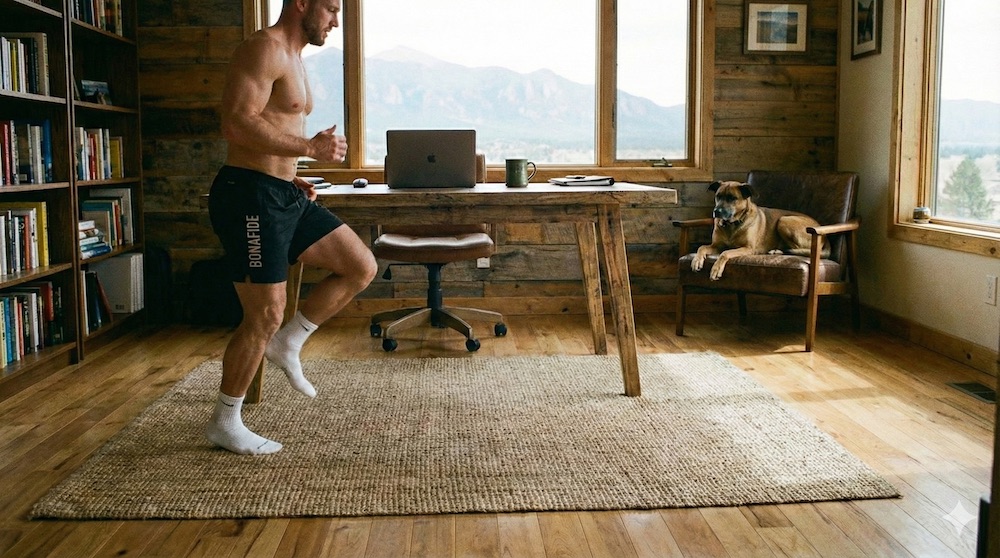
- The WFH Hack: High-performers are now placing their desks directly facing windows or using 10,000 lux "SAD lamps" for the first 30 minutes of the workday to "force-start" their internal engines.
2. The Evening "Shield": The Red Light Shift
As the sun goes down, the en vogue home office undergoes a transformation.
- The Science: Standard LED bulbs and computer screens emit blue light that tricks the brain into thinking it’s high noon. Red light, however, has a lower color temperature and doesn't disrupt melatonin production.
- The WFH Hack: 2026 has seen a surge in "Circadian Lighting" systems - smart bulbs that automatically shift from cool white to warm amber and eventually deep red as the evening progresses. This acts as a physiological "off-ramp," signaling to your nervous system that the work-threat is over and the recovery-phase has begun.
Designing Your "Luminous" Workflow
To master your light literacy, try this three-step environmental audit:
- The First 30 Minutes: Get outside. Even 5 minutes of direct sunlight (no sunglasses) tells your brain exactly what time it is. If you can't get out, use a high-intensity light therapy box at your desk.
- The "Midday Surge": Keep your workspace bright. Dim lighting in the afternoon is a signal to the body to slow down, which often manifests as the "afternoon slump."
- The 8:00 PM Blackout: Switch to "Sunset Mode." Turn off overhead lights and use lamps with warm or red-tinted bulbs. This creates a psychological and biological boundary between the "Office" and the "Home."
The Bottom Line: Light as a Drug
In 2026, we’ve realized that light is as pharmacologically active as caffeine. When you control your light environment, you stop fighting your biology and start using it. You aren't just decorating your room; you are programming your hormones for peak performance and deep recovery.